
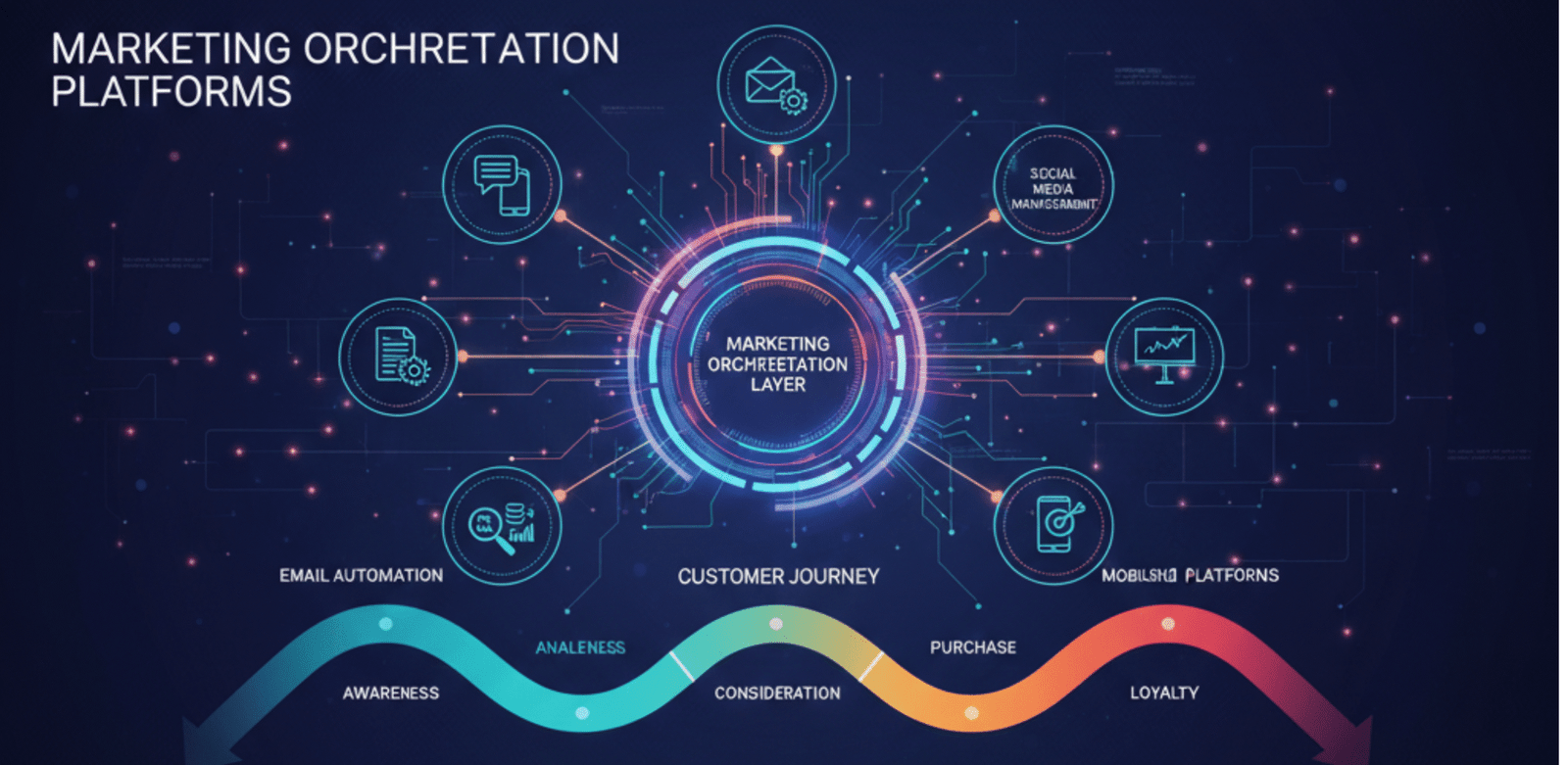
Marketing orchestration platforms are rapidly becoming the backbone of modern B2B marketing strategies. For years, marketing automation tools dominated the industry by helping teams manage email, campaigns, and lead-nurturing workflows. However, as customer journeys grow more complex and fragmented, traditional automation is no longer sufficient.
In 2026, B2B buyers interact with brands across dozens of touchpoints, both online and offline. They move between devices, platforms, and channels without following linear paths. As a result, marketing teams struggle to maintain consistency, personalization, and real-time responsiveness.
This challenge has created the rise of marketing orchestration.
What Is Marketing Orchestration?
Marketing orchestration is the practice of coordinating all marketing activities, data sources, and customer interactions into one unified system to deliver consistent and personalized experiences across every channel.
Instead of managing campaigns in isolation, marketing orchestration focuses on the entire customer journey. It brings together email platforms, CRM systems, advertising tools, website analytics, product data, and sales engagement platforms into a single operational layer.
The goal of marketing orchestration is not just execution. It is decision-making.
An orchestration platform continuously analyzes real-time buyer behavior and determines the best next action for each account or individual. This could mean triggering a personalized email, adjusting ad messaging, alerting sales, or recommending new content.
In simple terms:
- Marketing automation runs tasks.
- Marketing orchestration designs experiences.
This distinction is critical in 2026, when buyers expect seamless, relevant interactions across every touchpoint.
The Limitations of Traditional Marketing Automation
Marketing automation systems were designed to execute predefined workflows. While effective for basic campaigns, they face major limitations in modern environments.
First, automation relies heavily on static rules. These rules cannot adapt quickly to changing buyer behavior.
Second, most platforms operate in silos. They manage email or CRM data but lack visibility across paid media, website interactions, product usage, or sales engagement.
Third, automation focuses on execution, not intelligence. It delivers messages but does not understand context.
As a result, campaigns become disconnected, repetitive, and poorly timed.
How Marketing Orchestration Platforms Change the Model
Marketing orchestration platforms go beyond execution. They act as centralized intelligence systems that coordinate every customer interaction in real time.
Instead of managing isolated campaigns, orchestration platforms:
- Unify data from multiple systems
- Analyze real-time buyer behavior
- Decide the best next action
- Trigger personalized journeys
- Align marketing and sales execution
They do not replace automation tools. They sit above them and control how, when, and why automation occurs.
Key Business Benefits
Organizations that adopt marketing orchestration platforms experience measurable improvements.
Customer experience becomes seamless. Buyers receive relevant messages at the right time across channels.
Operational efficiency improves. Teams stop managing disconnected tools and start operating from a unified system.
Conversion rates increase. Engagement feels personalized instead of automated.
Data quality improves. Signals replace assumptions.
Most importantly, marketing becomes accountable for revenue, not just activity.
Common Mistakes to Avoid
Many companies fail by treating orchestration as just another tool.
One mistake is implementing orchestration without proper data integration. Without clean data, orchestration cannot function.
Another mistake is over-automation. Orchestration should enhance human strategy, not replace it.
Some teams also ignore organizational alignment. Orchestration requires marketing, sales, and operations to collaborate closely.
Technology alone does not create orchestration. Culture and process matter equally.
The Future of Marketing Orchestration Platforms
By 2028, marketing orchestration platforms will evolve into autonomous revenue systems.
AI will predict buyer intent before engagement occurs. Journeys will self-optimize based on performance. Sales actions will be triggered automatically by behavioral signals.
Marketing will no longer be about campaigns. It will become a continuous system of experience management.
Organizations that adopt orchestration early will gain a long-term competitive advantage.
Conclusion
Marketing orchestration platforms represent the next evolution of B2B marketing. They replace fragmented automation workflows with unified, intelligent systems that adapt to real buyer behavior.
In a world where customer journeys are complex and unpredictable, orchestration provides clarity, consistency, and control.
Companies that continue relying only on marketing automation will struggle to deliver meaningful experiences. Those who embrace orchestration will build scalable, predictable, and customer-centric growth engines for the future
