
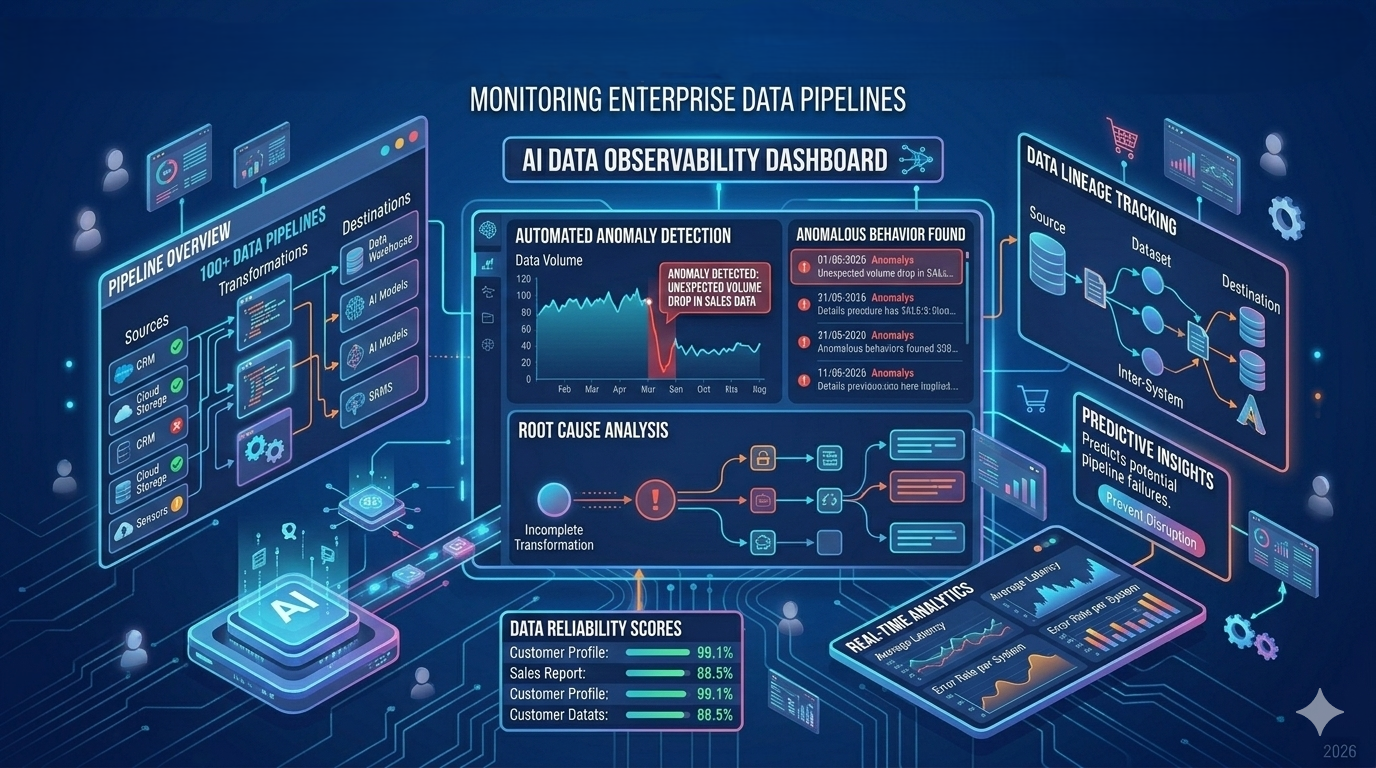
In today’s data-driven economy, businesses rely heavily on analytics, machine learning, and real-time decision-making. However, as organizations collect and process massive volumes of data across cloud platforms, maintaining data quality and reliability has become a major challenge. This is where AI data observability is emerging as a critical capability for modern enterprises. By combining artificial intelligence with advanced monitoring techniques, organizations can gain full visibility into their data pipelines, detect anomalies early, and ensure the accuracy of business insights.
As data ecosystems continue to expand, data observability is becoming just as important as traditional infrastructure monitoring.
What Is AI Data Observability?
AI data observability refers to the practice of monitoring and analyzing data systems using automated intelligence to ensure data reliability, quality, and performance.
It focuses on understanding how data moves through pipelines from collection and transformation to storage and analytics. By continuously tracking these processes, organizations can detect issues such as missing data, incorrect transformations, or unexpected anomalies.
Traditional monitoring tools often rely on static rules and manual oversight. AI-powered observability systems go further by learning patterns in data flows and automatically identifying irregular behavior.
This enables organizations to detect problems before they impact business operations.
Why Data Reliability Is Becoming a Business Priority
Modern organizations rely on data for everything from forecasting demand to optimizing marketing campaigns. If the underlying data is flawed, the decisions based on it can be equally flawed.
Several factors are increasing the need for data observability:
Rapid Growth of Data Pipelines
Enterprises now manage hundreds of data pipelines connecting multiple systems, including cloud platforms, analytics tools, and business applications.
Monitoring these pipelines manually is nearly impossible.
Increasing Dependence on AI Models
Machine learning models rely heavily on accurate training data. Poor data quality can lead to incorrect predictions and unreliable insights.
Real-Time Decision Making
Businesses increasingly rely on real-time analytics. Any delay or inconsistency in data pipelines can affect operational efficiency.
AI-driven observability helps organizations address these challenges by providing continuous visibility into data health.
Key Capabilities of AI Data Observability
AI-powered observability platforms offer several advanced capabilities that go beyond traditional monitoring tools.
Automated Anomaly Detection
Machine learning algorithms analyze historical data patterns and detect anomalies automatically.
For example, if a sales dataset suddenly drops in volume or shows unexpected spikes, the system can alert teams immediately.
Root Cause Analysis
AI systems can trace data issues back to their source, identifying whether the problem originated from a pipeline error, integration failure, or transformation issue.
Data Lineage Tracking
Observability tools map the entire journey of data across systems, showing how datasets move from source to destination.
This transparency helps teams understand dependencies and resolve issues faster.
Predictive Insights
AI can also predict potential pipeline failures before they occur by analyzing trends and system behavior.
This allows teams to prevent disruptions rather than simply reacting to them.
Benefits for Enterprise Organizations
Implementing AI-driven data observability provides several advantages for modern enterprises.
Improved Data Trust
When data quality is monitored continuously, organizations can trust their analytics and reporting systems.
Faster Issue Resolution
Automated alerts and root cause analysis significantly reduce the time required to detect and fix data problems.
Better AI Performance
Reliable data ensures machine learning models produce accurate predictions and insights.
Operational Efficiency
By automating monitoring tasks, data teams can focus on strategic initiatives instead of troubleshooting pipelines.
Common Challenges in Data Observability
Despite its benefits, implementing data observability requires careful planning.
Complex Data Environments
Large organizations often operate across hybrid and multi-cloud environments, making integration more challenging.
Data Governance Requirements
Organizations must ensure observability solutions comply with data privacy regulations and governance frameworks.
Cultural Adoption
Teams must adopt new monitoring practices and tools to fully benefit from observability strategies.
However, with the right approach, these challenges can be addressed effectively.
The Future of Data Infrastructure
As data ecosystems continue to expand, observability will become a core component of modern data architecture.
Just as DevOps teams monitor application performance, data teams will increasingly rely on observability tools to ensure pipeline reliability and data accuracy.
AI-driven monitoring will also evolve to provide deeper insights into data quality, governance, and operational efficiency.
Organizations that invest in data observability today will be better prepared to scale their data strategies in the future.
Conclusion
Data is the foundation of modern business decisions, but without reliability and transparency, it can quickly become a liability. AI data observability offers a powerful solution for monitoring complex data environments and maintaining trust in enterprise analytics.
By adopting AI-powered monitoring systems, organizations can detect issues earlier, improve operational efficiency, and unlock the full value of their data.
In a world where data drives innovation, ensuring its reliability is no longer optional it is essential.
