
Introduction
Risk has always been at the core of financial services. But in 2026, the way FinTech companies manage risk is undergoing a major transformation.
Traditional risk models, built on historical data and static rules, are no longer enough to handle today’s fast-moving, digital-first financial ecosystem.
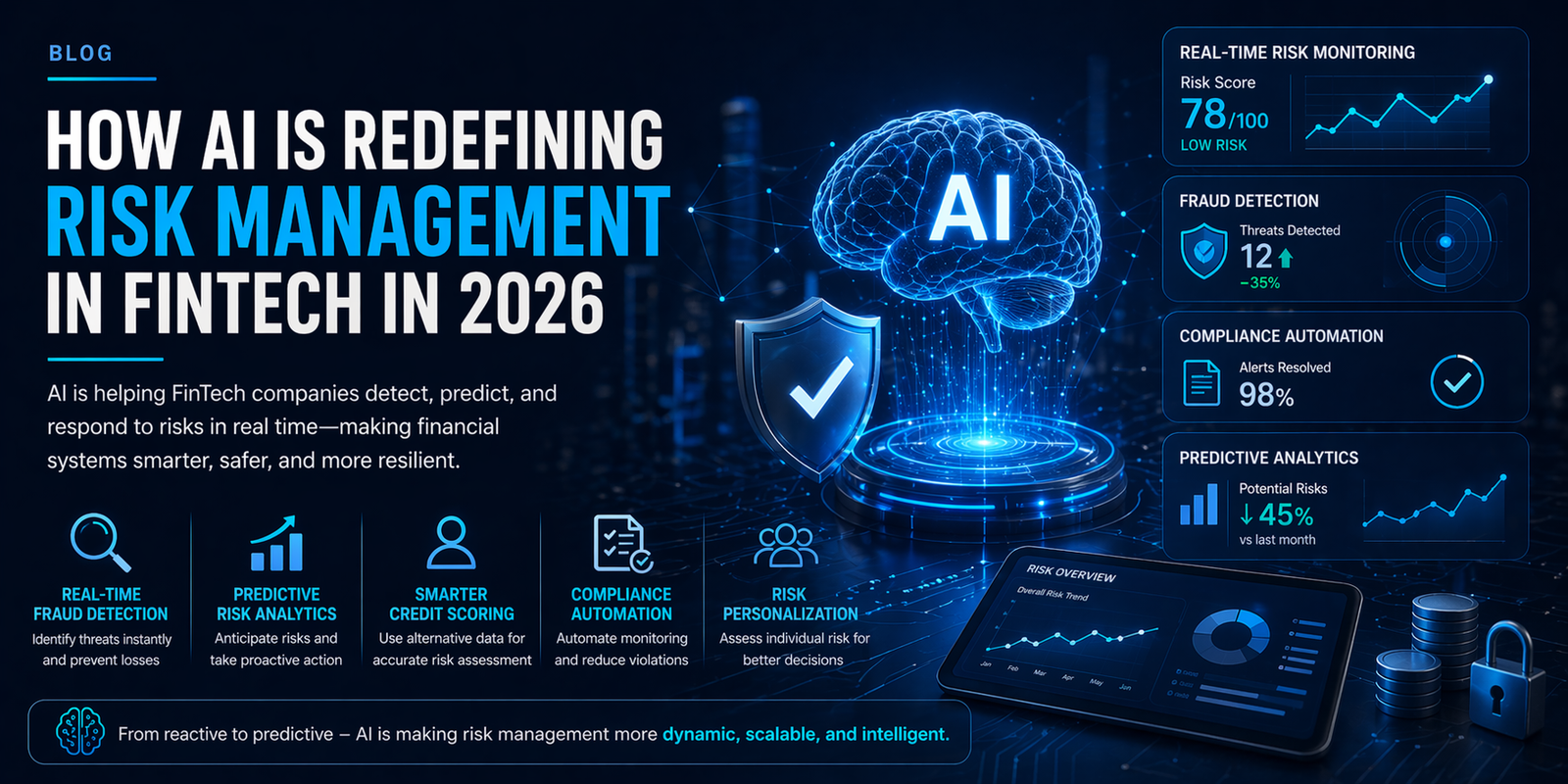
Artificial Intelligence (AI) is now playing a central role in helping FinTech companies detect, predict, and respond to risks in real time.
The Limitations of Traditional Risk Management
Legacy risk management systems rely heavily on predefined rules and past data. While effective in stable environments, they struggle with:
- Rapidly evolving fraud patterns
- High transaction volumes
- Real-time decision-making requirements
- Increasing regulatory complexity
These limitations create gaps that modern financial systems can no longer afford.
How AI Is Transforming Risk Management
1. Real-Time Fraud Detection
AI systems can analyze thousands of transactions per second, identifying unusual patterns and flagging suspicious activity instantly.
Unlike rule-based systems, AI adapts continuously, making it more effective against evolving fraud tactics.
2. Predictive Risk Analytics
AI enables FinTech companies to move from reactive to predictive risk management.
By analyzing behavioral data and historical trends, AI can forecast potential risks before they occur, allowing businesses to take proactive action.
3. Smarter Credit Scoring
Traditional credit scoring models often rely on limited financial history.
AI expands this by incorporating alternative data sources such as:
- Transaction behavior
- Digital footprints
- Spending patterns
This leads to more accurate and inclusive credit assessments.
4. Regulatory Compliance Automation
Compliance is one of the biggest challenges in FinTech.
AI helps automate compliance processes by:
- Monitoring transactions in real time
- Detecting anomalies
- Generating audit trails
This reduces manual effort and minimizes the risk of regulatory violations.
5. Risk Personalization
AI allows financial institutions to assess risk at an individual level rather than using generalized models.
This enables:
- Personalized financial products
- Better customer segmentation
- Improved decision-making
Business Impact of AI in FinTech
Companies adopting AI-driven risk management are seeing:
- Reduced fraud losses
- Faster decision-making
- Lower operational costs
- Improved customer trust
AI is not just improving risk management it is making it more dynamic, scalable, and intelligent.
Challenges in AI Adoption
Despite its advantages, implementing AI in risk management comes with challenges:
- Data quality and availability
- Integration with legacy systems
- Regulatory and ethical concerns
- Need for skilled talent
Addressing these challenges is critical for successful adoption.
The Future of Risk Management in FinTech
As AI continues to evolve, risk management will become more automated and predictive.
Future trends include:
- Real-time risk scoring
- AI-driven decision engines
- Cross-platform risk intelligence
- Enhanced fraud prevention systems
The focus will shift from managing risk to anticipating it.
Conclusion
AI is redefining how FinTech companies approach risk management.
By enabling real-time insights, predictive analytics, and automation, AI is helping businesses stay ahead of threats while improving efficiency and trust.
In an increasingly complex financial landscape, AI-driven risk management is no longer optional it is essential.
