
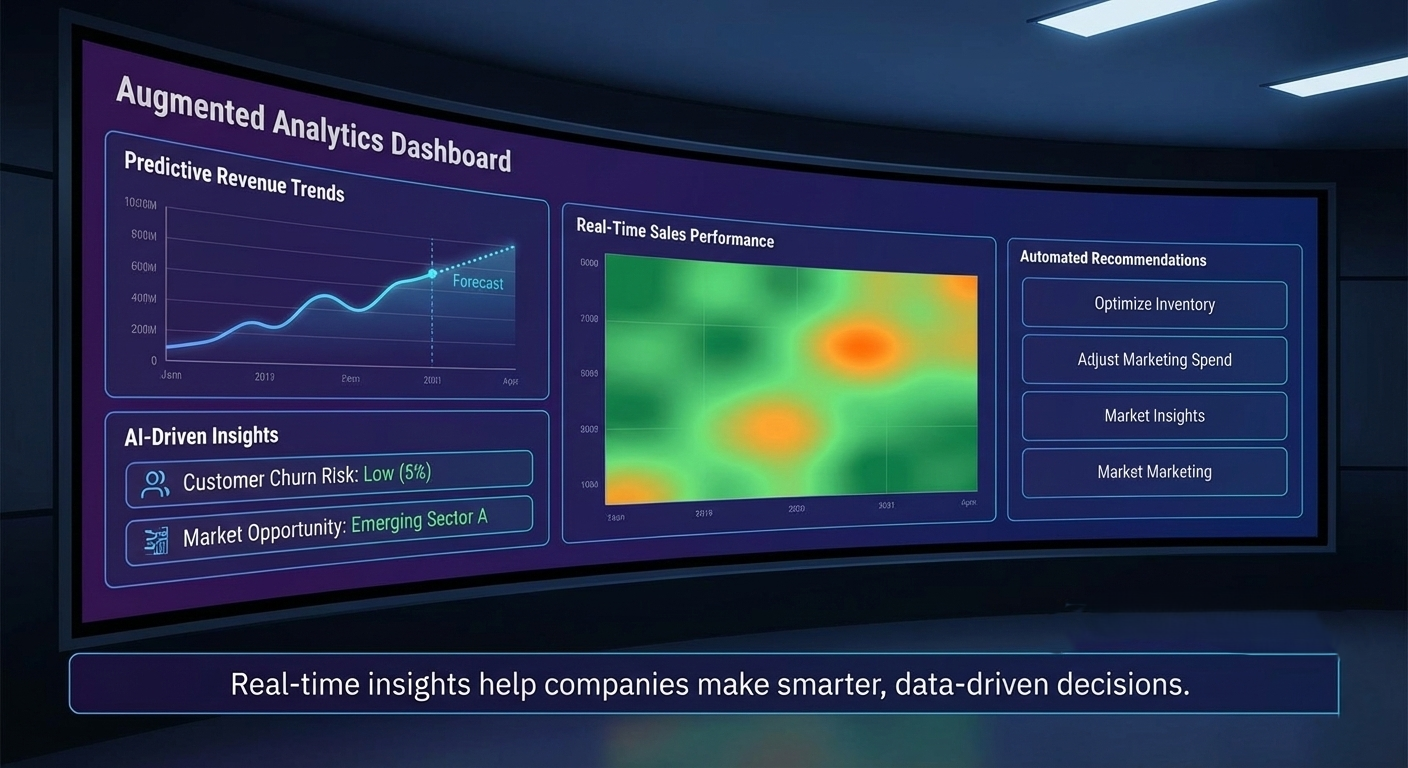
In today’s fast-paced business world, companies are flooded with data from every source, including customer interactions, operational systems, and market trends. The challenge is not collecting data but transforming it into actionable insights. This is where augmented analytics comes in. By leveraging AI, machine learning, and advanced data visualization, organizations can analyze information faster, make smarter decisions, and anticipate trends before they happen.
Unlike traditional analytics, which often relies on manual interpretation and multiple tools, augmented analytics automates much of the data preparation and insight generation. This allows teams to focus on strategy and execution rather than spending hours sifting through spreadsheets. Organizations that adopt these solutions gain a competitive edge by reacting quickly to changing market conditions.
What Is Augmented Analytics?
At its core, augmented analytics combines AI-powered intelligence with visualization tools to help businesses understand data more effectively. Instead of just producing charts or tables, these platforms detect patterns, highlight correlations, and suggest actionable steps.
For example:
- Retailers can predict customer buying behavior and optimize stock levels.
- Financial institutions can forecast revenue trends and detect anomalies.
- Healthcare providers can analyze patient outcomes and operational efficiency.
By automating routine data analysis, augmented analytics helps teams focus on meaningful insights rather than mundane tasks, bridging the gap between raw data and real-world decisions.
Benefits for Modern Businesses
1. Accelerated Decision-Making
Real-time insights allow leaders to respond to opportunities and threats quickly, reducing delays caused by manual reporting.
2. Improved Forecasting
Predictive analytics and trend detection help companies anticipate market shifts and adjust strategies proactively.
3. Enhanced Operational Efficiency
Automation of repetitive tasks reduces workload on data teams, letting them focus on strategy and execution.
4. Fostering a Data-Driven Culture
Employees across departments can access insights easily, encouraging smarter collaboration and decision-making.
A retail chain, for example, can use these tools to identify trending products in certain regions, optimize inventory, and launch targeted campaigns without manually analyzing sales data.
Real-World Applications
Marketing and Customer Engagement
Advanced analytics allows marketing teams to personalize campaigns at scale. AI models identify user preferences, recommend products, and suggest the optimal timing for engagement.
Finance and Risk Management
Companies use intelligent analytics to detect fraud, monitor compliance, and forecast budgets. The AI-driven system quickly spots unusual patterns, enabling swift, proactive action.
Operations and Supply Chain
Supply chain managers rely on predictive insights to prevent disruptions, optimize logistics, and maintain smooth operations, making processes faster and more cost-efficient.
Tools Powering Augmented Analytics
Several platforms enable augmented analytics capabilities:
- Tableau – AI-driven visualizations and predictive insights.
- Microsoft Power BI – Integrates machine learning for forecasting and natural language queries.
- Qlik Sense – Detects patterns automatically and provides actionable recommendations.
These solutions democratize access to insights, allowing business users, analysts, and decision-makers to leverage data without being data scientists.
Challenges to Consider
While powerful, these tools require careful planning:
- Data Quality: Insights are only as good as the data they analyze.
- Integration: Platforms must connect with existing systems seamlessly.
- User Adoption: Teams need guidance to interpret AI-driven recommendations accurately.
By addressing these factors, organizations ensure that analytics tools deliver maximum impact without confusion or misuse.
The Future of Augmented Analytics
The next wave of data analysis will be even more predictive and prescriptive. Organizations will move from reactive insights to proactive strategies. Combining human judgment with AI-driven recommendations, businesses can anticipate customer behavior, optimize operations, and stay ahead of competitors.
As companies increasingly adopt cloud-based tools and machine learning models, augmented analytics becomes a critical component of data-driven growth and innovation.
Conclusion
Augmented analytics is transforming how organizations interact with data. By leveraging AI-powered insights, businesses can turn complex information into actionable decisions, streamline operations, and enhance customer experiences. From personalized marketing to predictive forecasting, intelligent analytics empowers teams to act faster and smarter.
Companies embracing these solutions gain a strategic advantage, anticipating trends, reducing inefficiencies, and building a culture rooted in data. As technology evolves, augmented analytics will remain a cornerstone for businesses seeking sustainable growth, competitive agility, and smarter decision-making.
