
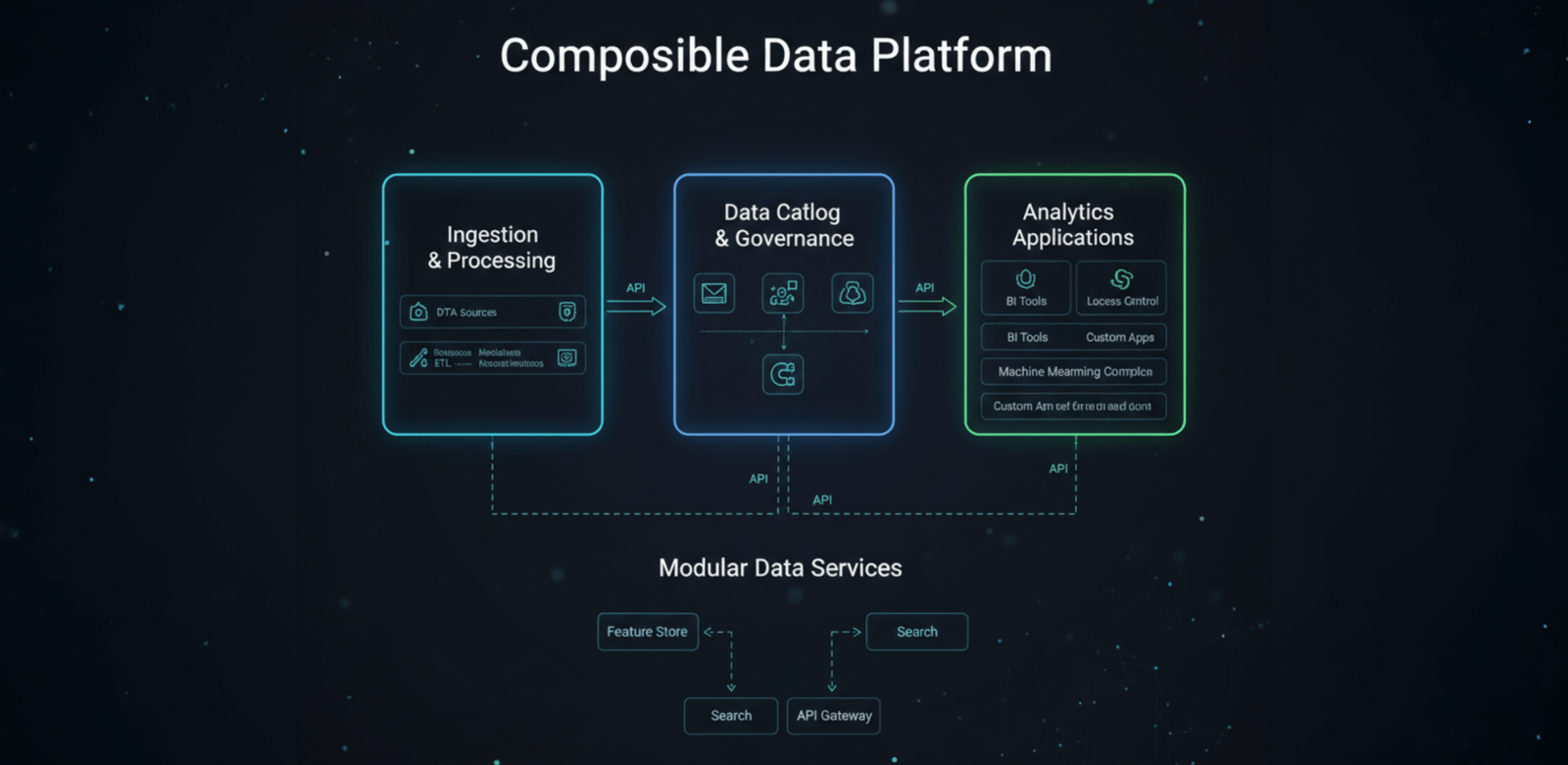
Composable data platforms are reshaping how enterprises design analytics systems. For years, organizations depended on large, monolithic platforms that attempted to manage data ingestion, storage, processing, and visualization within a single environment. Although these systems offered convenience, they increasingly struggle to meet modern business requirements.
In 2026, enterprises operate across distributed clouds, multiple business units, and real-time data streams. As a result, traditional analytics platforms often feel rigid, slow, and expensive to maintain. Composable data platforms introduce a modular approach, allowing organizations to build flexible analytics ecosystems using specialized, interoperable components.
Why Monolithic Analytics Is Breaking Down
Traditional analytics systems were built for stable environments with predictable workloads. However, modern enterprises face constant technological change and growing data complexity.
Several limitations have become clear:
- Scalability issues as data volumes increase
- Vendor lock-in that restricts innovation
- Slow deployment cycles for new capabilities
- Limited integration with emerging technologies
Consequently, many organizations find themselves constrained by the very platforms designed to support them.
What Are Composable Data Platforms?
Composable data platforms allow enterprises to assemble analytics stacks from independent services. Each component performs a specific function and can be replaced or upgraded without affecting the entire system.
Typical components include:
- Cloud-based data warehouses
- Real-time streaming engines
- Machine learning services
- Modular visualization tools
- API-driven integration layers
Instead of relying on a single vendor, organizations create customized data ecosystems tailored to their evolving needs.
Business Benefits of a Composable Approach
Composable architectures enable analytics systems to evolve continuously. This flexibility delivers significant strategic advantages.
First, organizations can experiment with new technologies without platform disruption. Second, teams can deploy advanced analytics faster, reducing time-to-insight. Third, modular systems improve resilience, as individual components can fail without collapsing the entire ecosystem.
Moreover, composable platforms support cross-functional collaboration. Marketing, finance, operations, and IT teams can use different tools while sharing a common data foundation.
Impact on Enterprise Decision-Making
Composable data platforms shift analytics from static reporting to dynamic decision systems. Instead of analyzing past events, organizations monitor real-time signals and adjust strategies instantly.
For example, marketing teams integrate live customer behavior data to optimize campaigns. Meanwhile, operations teams monitor supply chains using streaming analytics. Financial leaders evaluate performance through predictive forecasting models.
Through modular systems, enterprises move closer to real-time intelligence.
Governance and Security Challenges
While composable systems offer flexibility, they also introduce complexity. Managing security, compliance, and data quality across multiple platforms requires strong governance.
Key challenges include:
- Identity and access control across tools
- Data consistency between systems
- Cost management in cloud environments
- Performance monitoring across services
Therefore, enterprises must implement orchestration layers and centralized governance frameworks to maintain control.
The Future of Enterprise Analytics
Composable data platforms represent a fundamental shift in how organizations view analytics. Rather than building static systems, enterprises design adaptive data ecosystems that evolve continuously.
In the coming years, analytics will become:
- More decentralized
- More automated
- More integrated with AI systems
- More responsive to business change
Organizations that embrace composable architectures will gain faster insights, lower operational risk, and greater strategic agility.
Conclusion
Composable data platforms signal the end of monolithic analytics. In 2026, enterprises require systems that adapt as quickly as their markets. By assembling modular, interoperable components, organizations build analytics ecosystems that support continuous innovation.
Ultimately, composable platforms do not just improve data processing, they redefine how businesses transform information into intelligence. Organizations that embrace this approach can respond faster to market changes, experiment safely with emerging technologies, and maintain a competitive edge in an increasingly digital world. Composable analytics is no longer optional; it is becoming a core pillar of enterprise strategy.
