
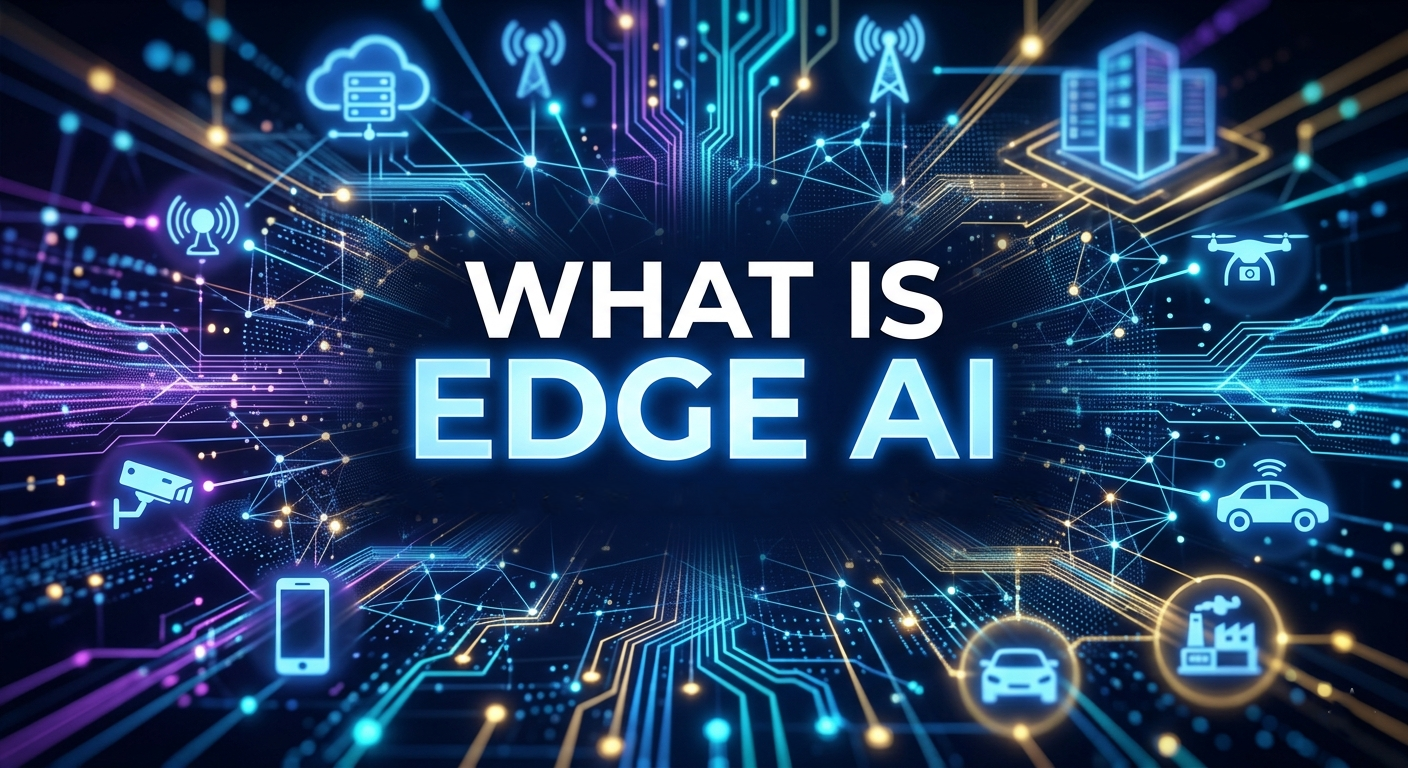
As businesses become increasingly data-driven, the ability to process and act on data in real time is becoming a critical competitive advantage. Traditional cloud-based AI models, while powerful, often struggle with latency, bandwidth limitations, and real-time responsiveness. To overcome these challenges, organizations are turning to Edge AI in enterprises, a model where artificial intelligence processes data closer to the source rather than relying solely on centralized cloud systems.
What Is Edge AI?
Edge AI refers to the deployment of AI models directly on edge devices such as sensors, cameras, IoT devices, and local servers. Instead of sending data to the cloud for processing, the analysis happens at or near the data source.
This approach reduces latency, improves speed, and enables real-time decision-making.
Why Edge AI Is Gaining Momentum
Need for Real-Time Insights
Industries such as manufacturing, healthcare, and logistics require instant data processing.
Reduced Latency
Processing data locally eliminates delays caused by cloud communication.
Bandwidth Optimization
Less data needs to be transmitted to the cloud, reducing network load.
Enhanced Data Privacy
Sensitive data can be processed locally without being transmitted externally.
Key Use Cases in Enterprises
Smart Manufacturing
Edge AI enables real-time monitoring of equipment, reducing downtime and improving efficiency.
Retail Analytics
Businesses can analyse customer behaviour in real time to optimize store layouts and experiences.
Healthcare Applications
Medical devices can process patient data in real time, improving diagnosis and response times.
Logistics and Supply Chain
Real-time tracking and predictive analytics improve operational efficiency.
Benefits for Enterprises
Faster Decision-Making
Real-time insights enable immediate action.
Improved Efficiency
Automation at the edge reduces reliance on centralized systems.
Enhanced Security
Local data processing minimizes exposure to external threats.
Scalability
Edge AI systems can scale across multiple locations and devices.
Challenges to Consider
- Managing distributed infrastructure
- Ensuring model consistency across devices
- Hardware limitations at the edge
Despite these challenges, advancements in AI hardware and software are making edge deployments more practical.
The Future of Edge AI
Edge AI is expected to play a key role in the future of enterprise technology. As IoT adoption grows and real-time data becomes more critical, edge computing will become integral to AI strategies.
Organizations that adopt edge AI early will gain a competitive advantage through faster insights and improved operational efficiency.
Conclusion
The shift toward real-time intelligence is reshaping enterprise technology. Edge AI in enterprises enables organizations to process data faster, reduce latency, and make smarter decisions.
As businesses continue to evolve, edge AI will become a foundational component of digital transformation strategies.
