
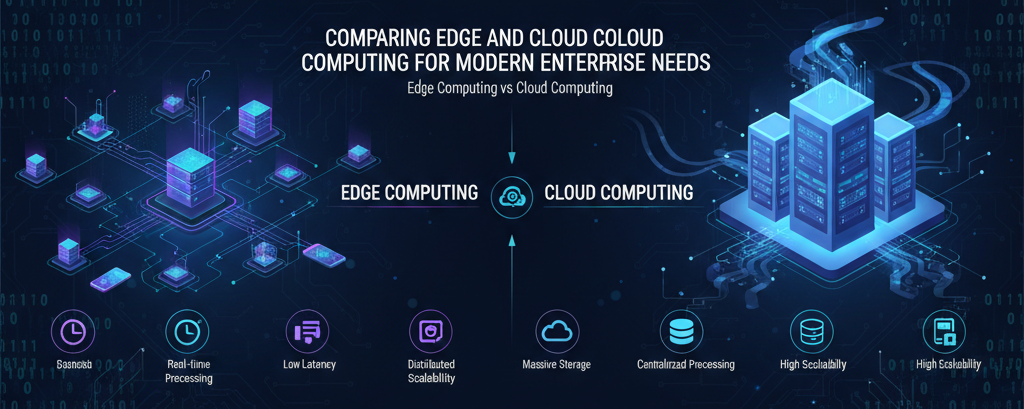
Edge computing vs cloud computing is no longer just a technical debate, it has become a strategic decision for enterprises in 2026. As businesses demand faster processing, real-time insights, and scalable infrastructure, choosing the right computing model directly impacts performance, cost, and customer experience.
While cloud computing has dominated enterprise IT for years, edge computing is rapidly gaining traction. The question is no longer which one is better, but where each fits best.
What Is Cloud Computing?
Cloud computing allows businesses to store, manage, and process data on centralized remote servers instead of local systems.
It offers:
- High scalability
- Cost efficiency
- Remote accessibility
- Centralized data management
Cloud platforms have become the backbone of modern digital transformation, enabling organizations to scale operations without heavy infrastructure investments.
What Is Edge Computing?
Edge computing brings data processing closer to the source, whether it’s a device, sensor, or local server.
Instead of sending all data to the cloud, edge computing processes it locally, reducing latency and improving speed.
This is especially useful for:
- IoT devices
- Real-time applications
- Autonomous systems
- Smart infrastructure
Edge Computing vs Cloud Computing: Key Differences
1. Data Processing Location
Cloud computing processes data in centralized data centers.
Edge computing processes data closer to where it is generated.
2. Latency and Speed
Cloud may experience delays due to data travel time.
Edge enables real-time processing with minimal latency.
3. Scalability
Cloud platforms are highly scalable and flexible.
Edge systems require distributed infrastructure planning.
4. Cost Structure
Cloud reduces upfront infrastructure costs.
Edge can reduce long-term data transfer and bandwidth costs.
5. Security
Cloud providers offer strong centralized security.
Edge reduces exposure by limiting data movement but requires distributed security management.
When Should Businesses Choose Cloud Computing?
Cloud computing remains ideal for:
- Large-scale data storage
- Centralized applications
- Remote collaboration
- Non-real-time workloads
It is particularly useful for businesses that prioritize scalability and flexibility over speed.
When Should Businesses Choose Edge Computing?
Edge computing is better suited for:
- Real-time decision-making
- Low-latency applications
- IoT ecosystems
- Remote or bandwidth-limited environments
Industries like healthcare, manufacturing, and logistics are increasingly adopting edge for faster operations.
Why the Future Is Hybrid
In 2026, the conversation around edge computing vs cloud computing is shifting toward integration rather than replacement.
Most enterprises are adopting a hybrid approach, combining the strengths of both models.
- Edge handles real-time processing
- Cloud manages storage and large-scale analytics
This balance enables businesses to optimize performance while maintaining scalability.
Business Impact of Choosing the Right Model
Selecting the right computing strategy affects multiple aspects of a business:
Customer Experience
Faster processing leads to better user interactions and satisfaction.
Operational Efficiency
Reduced latency improves system performance and decision-making speed.
Cost Optimization
Balancing cloud and edge can help control infrastructure and bandwidth costs.
Innovation Potential
Real-time capabilities enable new products, services, and business models.
Common Mistakes to Avoid
One common mistake is assuming one model can replace the other.
Both cloud and edge serve different purposes, and choosing only one can limit capabilities.
Another mistake is ignoring use-case requirements. Businesses must align their computing strategy with specific operational needs rather than trends.
The Future of Enterprise Computing
As digital transformation accelerates, enterprises will increasingly rely on a combination of edge and cloud technologies.
Future trends include:
- AI-powered edge systems
- Real-time analytics at scale
- Distributed cloud architectures
- Increased adoption of IoT-driven solutions
The focus will shift from infrastructure selection to intelligent orchestration.
Conclusion
The debate around edge computing vs cloud computing is evolving into a more strategic discussion about how businesses can leverage both technologies effectively. Each model offers distinct advantages, and the real value lies in understanding where and how to use them.
Enterprises that adopt a balanced approach will be better positioned to deliver faster services, improve operational efficiency, and stay competitive in an increasingly digital landscape.
In 2026, success is not about choosing between edge and cloud, it is about integrating both to build a smarter, more responsive enterprise ecosystem.
