
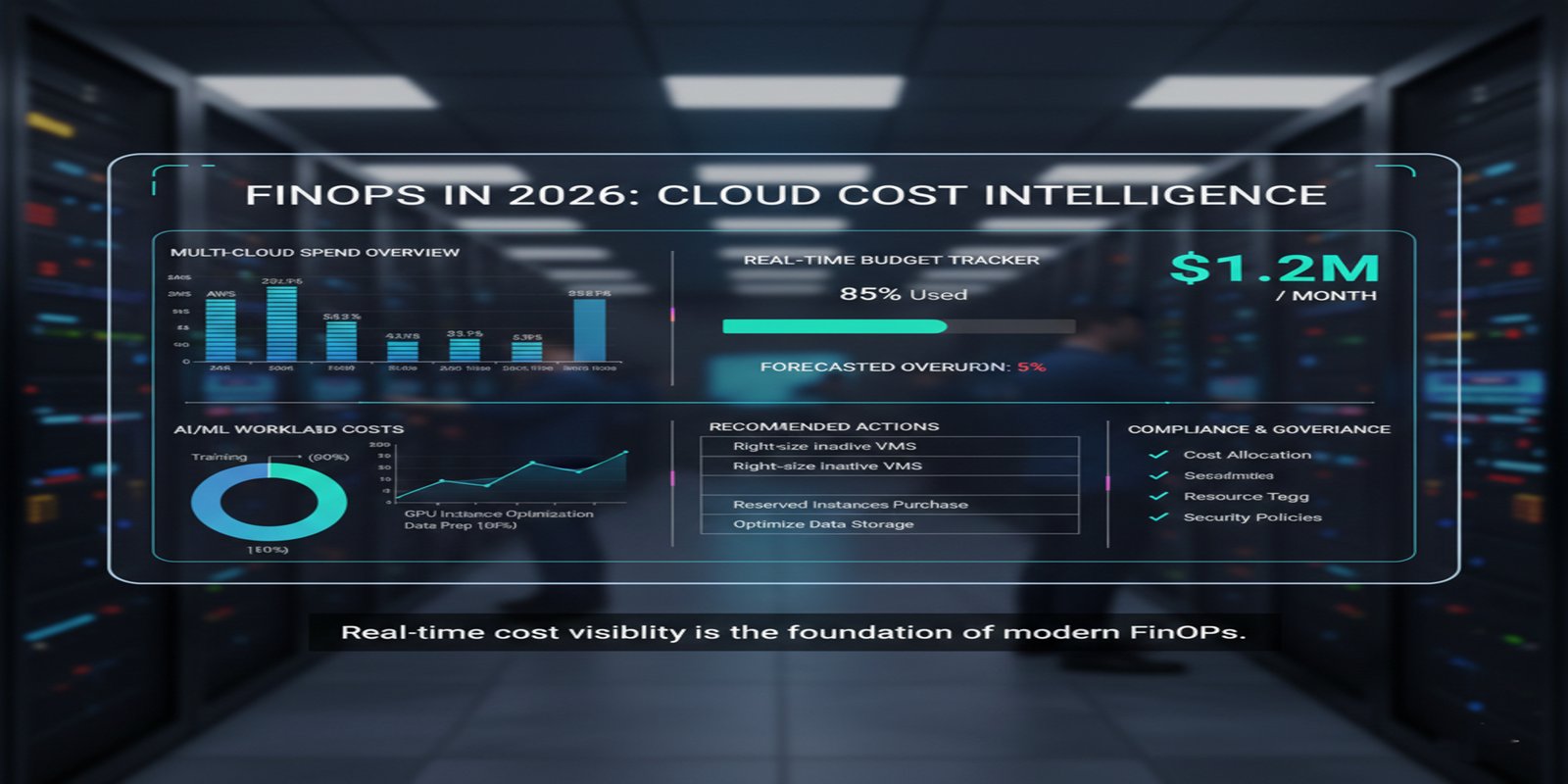
In 2026, cloud spending has become one of the largest operational expenses for modern enterprises. As organisations scale across multi-cloud environments and invest heavily in AI-driven systems, financial control is no longer just an economic concern, it is a strategic business priority. FinOps in 2026 represents a new operating model where finance, engineering, and leadership work together to ensure cloud investments generate real business value.
Unlike traditional cost management, FinOps focuses on real-time financial visibility, accountability, and continuous optimization. Instead of reacting to monthly cloud bills, organizations are now proactively managing consumption, forecasting costs, and aligning every digital initiative with measurable ROI.
What Is FinOps and Why It Matters Now
FinOps, short for Financial Operations, is a framework that helps organizations manage and optimize cloud spending. It brings together financial governance, engineering insights, and operational discipline into a single model.
In the past, cloud adoption was driven by speed and flexibility. Teams could deploy resources instantly without much financial oversight. However, as businesses adopted AI, machine learning, and data-intensive platforms, cloud costs grew exponentially, often without clear ownership.
FinOps in 2026 shifts the mindset from “use first, review later” to “optimize continuously.” It ensures that every cloud resource, from virtual machines to GPU clusters, is tracked, measured, and aligned with business outcomes.
The Real Challenge: Cloud Costs Are No Longer Predictable
Modern cloud environments are highly dynamic. AI workloads scale automatically. Data pipelines run continuously. SaaS tools integrate across departments. While this enables innovation, it also creates financial blind spots.
The biggest challenge companies face today is not cloud pricing. It is a lack of visibility.
Without FinOps practices, organizations struggle with:
- Unexpected cost spikes
- Idle resources consume budgets
- Duplicate services across teams
- AI workloads running without limits
- Difficulty forecasting future spend
This is why FinOps in 2026 is no longer optional. It has become essential for maintaining financial discipline in a digital-first world.
How FinOps Is Evolving in 2026
FinOps today is far more advanced than simple cost dashboards. It now integrates automation, AI-driven insights, and predictive financial modelling.
Modern FinOps capabilities include:
1. Real-Time Financial Visibility
Organizations can monitor cloud spend instantly across AWS, Azure, and Google Cloud. Teams no longer wait for monthly invoices, they act in real time.
2. AI-Based Cost Optimization
AI engines automatically detect waste, underutilized resources, and inefficient workloads. This allows organizations to reduce costs without impacting performance.
3. Cross-Team Accountability
Engineering teams understand financial impact. Finance teams understand technical usage. Leadership gains a unified view of digital investments.
4. Predictive Budget Forecasting
Using historical data and usage trends, companies can accurately forecast cloud costs for upcoming projects and product launches.
This evolution makes FinOps in 2026 more strategic than tactical, it drives decision-making, not just reporting.
FinOps and AI: The Most Important Relationship
AI is the biggest driver of cloud spending today. Training models, running inference, and storing massive datasets require high-performance infrastructure.
Without financial governance, AI projects can become extremely expensive with unclear returns.
FinOps enables organizations to:
- Track GPU and compute usage
- Optimize AI training costs
- Allocate budgets per model or team
- Measure ROI of AI initiatives
- Prevent runaway automation expenses
In FinOps in 2026, AI is no longer treated as an experimental cost, it is managed as a core business investment.
Why CFOs and CTOs Are Now Aligned on FinOps
Historically, finance and technology operated in silos. Cloud changed that.
Today, every major digital initiative has financial consequences. Product teams cannot scale features without a budget impact. AI teams cannot train models without compute costs. Marketing cannot run real-time analytics without a data infrastructure.
FinOps creates a shared language between CFOs and CTOs. It allows leaders to make smarter trade-offs between innovation and financial sustainability.
With FinOps in 2026, cloud is no longer seen as a technical platform, it is treated as a financial asset that must deliver measurable business value.
The Business Impact of Strong FinOps Practices
Organizations that implement mature FinOps models consistently report:
- 20–40% reduction in cloud waste
- Faster financial decision-making
- Improved ROI on AI investments
- Higher accountability across teams
- Better alignment between strategy and execution
FinOps does not slow innovation. It enables smarter growth.
Instead of cutting costs blindly, businesses learn where to invest more and where to optimize. This balance is what makes FinOps powerful in modern enterprises.
FinOps as a Competitive Advantage
In highly competitive industries, the ability to control digital spending directly impacts profitability. Companies that master FinOps can scale faster, launch products confidently, and invest in AI without fear of financial instability.
FinOps is no longer about saving money. it is about using money intelligently.
Organizations that ignore this shift risk falling behind. Those who adopt FinOps in 2026 gain clarity, control, and long-term resilience.
Conclusion
FinOps in 2026 represents a fundamental shift in how businesses manage digital growth. It transforms cloud spending from an unpredictable expense into a strategic investment. As AI adoption accelerates and cloud ecosystems become more complex, financial governance will define which organizations succeed and which struggle to scale.
The future of enterprise technology will not be driven by infrastructure alone, but by financial intelligence. Companies that embrace FinOps today are not just optimizing costs, they are building a sustainable foundation for innovation, profitability, and long-term leadership in the digital economy.
