
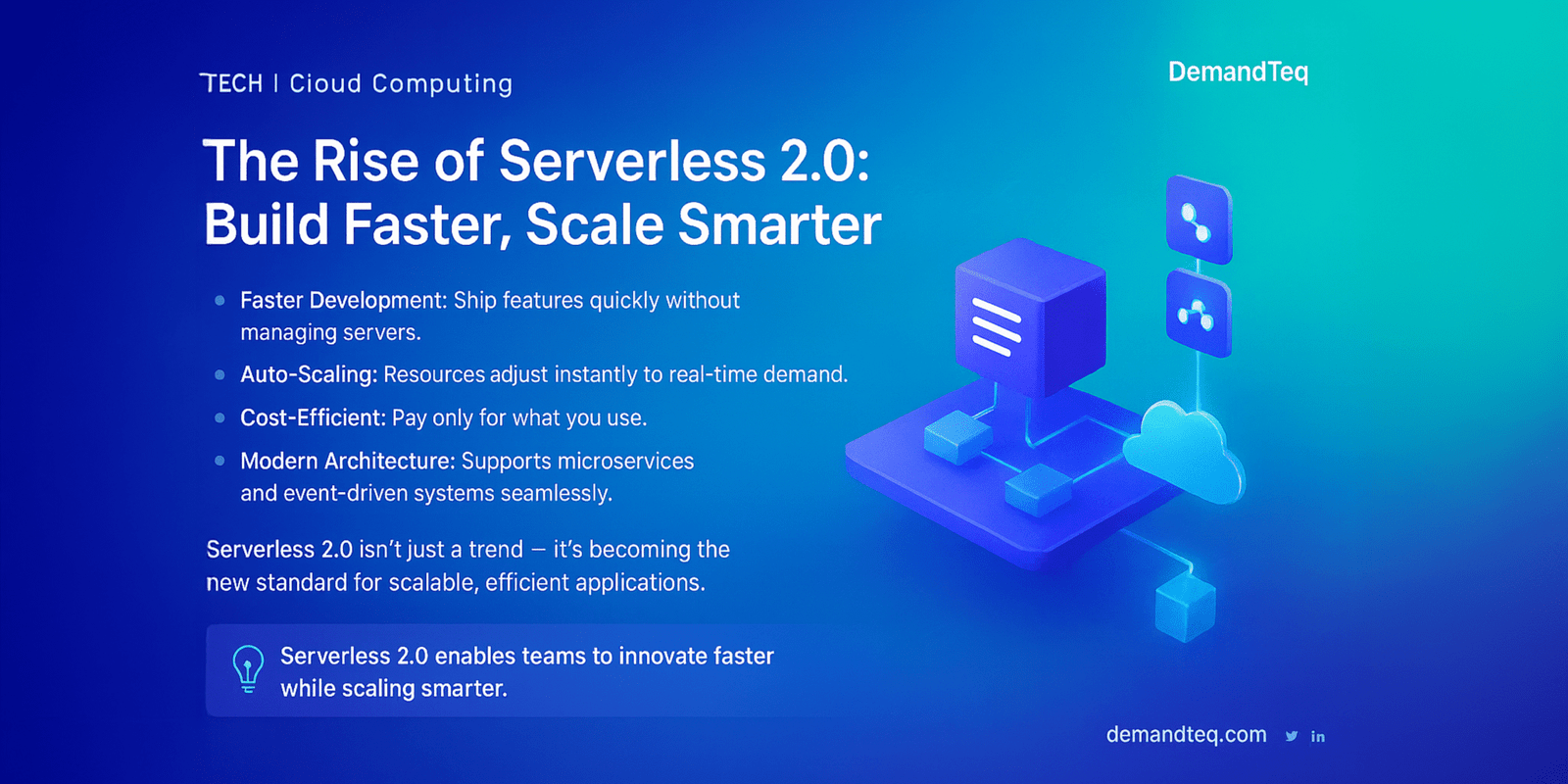
In today’s fast-moving digital landscape, businesses face increasing pressure to release applications faster, optimize costs, and scale efficiently. Enter Serverless 2.0, a new evolution of serverless computing that empowers developers to focus on writing code rather than managing infrastructure while unlocking advanced scalability, flexibility, and smarter operational efficiency. The rise of this next-generation serverless architecture is transforming how organizations build, deploy, and maintain applications in 2025 and beyond.
Unlike traditional server-based architectures, Serverless 2.0 abstracts away most infrastructure management. Developers no longer worry about provisioning servers, handling capacity planning, or dealing with maintenance headaches. Instead, they can write functions or services that automatically scale depending on demand. This approach accelerates development cycles, reduces operational overhead, and enables businesses to respond to user needs in real time, making it a game-changer for modern software teams.
Serverless computing also empowers organizations to adopt agile development and continuous delivery practices more effectively. Teams can experiment, test, and deploy features rapidly without waiting for IT infrastructure changes. The combination of speed, reliability, and minimal management overhead is helping companies stay ahead of competitors in industries where time-to-market is critical.
Why Serverless 2.0 Matters
The previous generation of serverless solutions offered convenience but had limitations, including cold starts, complex debugging, and vendor lock-in. This modern serverless platform addresses these challenges through improvements like:
- Faster cold starts: Functions start almost instantly, improving application responsiveness.
- Enhanced observability: Real-time monitoring, logging, and tracing for better operational insights.
- Improved multi-cloud support: Greater portability across cloud providers reduces dependency on a single vendor.
- Event-driven orchestration: Simplified integration with APIs, databases, and messaging systems enables automated workflows.
These advancements allow teams to deploy complex applications with minimal friction, providing a platform that scales dynamically as the business grows.
Accelerate Development Cycles
With this next-generation serverless computing, developers can move from idea to production faster than ever. By focusing purely on business logic instead of infrastructure, teams can:
- Deploy microservices independently
- Test and iterate on new features rapidly
- Avoid resource wastage with auto-scaling functions
- Leverage pre-built connectors to databases, storage systems, and third-party APIs
For example, a fintech company launching a new payment feature can deploy updates instantly without worrying about server downtime. This not only speeds up delivery but encourages innovation, as developers can experiment freely without heavy infrastructure commitments.
Scaling Smarter, Not Harder
Traditional architectures require manual scaling and over-provisioning, which can be both costly and inefficient. Serverless 2.0 automatically scales based on actual demand. Applications experience near-instant elasticity during peak traffic and scale down during low usage periods. This ensures reliability while optimizing operational costs.
Additionally, the platform enables fine-grained resource allocation, allowing organisations to pay only for what they use rather than scale entire servers unnecessarily. Startups and enterprises alike benefit from this efficiency, whether handling thousands or millions of user requests.
Security and Reliability
Security and reliability are critical for modern applications. Serverless 2.0 platforms prioritize both by offering built-in protections like function isolation, automatic patching, and integrated authentication. Developers can focus on application-level security without worrying about infrastructure vulnerabilities.
Advanced features such as retry mechanisms, distributed tracing, automated failover, and compliance certifications ensure applications remain reliable even under high load or unexpected failures. This makes the modern serverless architecture suitable for industries with strict regulatory requirements, such as healthcare and financial services.
Real-World Applications of Serverless 2.0
This next-gen serverless model is already proving transformative across industries:
- E-commerce: Flash sales and sudden spikes in website traffic can be handled seamlessly with auto-scaling serverless APIs.
- FinTech: Event-driven functions process transactions in real time, enhancing security and responsiveness.
- Media & Entertainment: Video encoding, streaming, and content delivery pipelines scale automatically based on user demand.
- Healthcare: Secure, HIPAA-compliant workflows enable patient data processing and telehealth solutions without infrastructure bottlenecks.
- Travel & Hospitality: Real-time availability checks, personalized offers, and booking confirmations are handled instantly with minimal latency.
These examples demonstrate how this modern serverless platform allows businesses to meet customer expectations while reducing costs and complexity.
Conclusion
The rise of Serverless 2.0 is redefining modern software development. Abstracting infrastructure management, improving performance, and providing intelligent auto-scaling allows developers to focus on delivering value faster. Businesses adopting this next-generation serverless model can accelerate development cycles, optimize costs, improve reliability, and enhance user experiences across industries.
As digital ecosystems become more complex, this serverless platform offers a smarter, more flexible, and future-ready approach. Companies leveraging it gain the ability to innovate rapidly, respond instantly to user needs, and maintain operational efficiency. Whether deploying new features, processing real-time events, or scaling globally, the modern serverless architecture empowers teams to build confidently and achieve measurable business outcomes.
In essence, organizations that embrace this evolution of serverless computing are not just reducing operational overhead, they are strategically positioning themselves for faster growth, higher customer satisfaction, and long-term success in an increasingly competitive digital world.

My spouse and I stumbled over here coming from a different website and thought I should check things out. I like what I see so i am just following you. Look forward to checking out your web page repeatedly.
Woah! I’m really enjoying the template/theme of this website. It’s simple, yet effective. A lot of times it’s hard to get that “perfect balance” between usability and visual appeal. I must say you’ve done a fantastic job with this. Additionally, the blog loads extremely fast for me on Safari. Excellent Blog!