
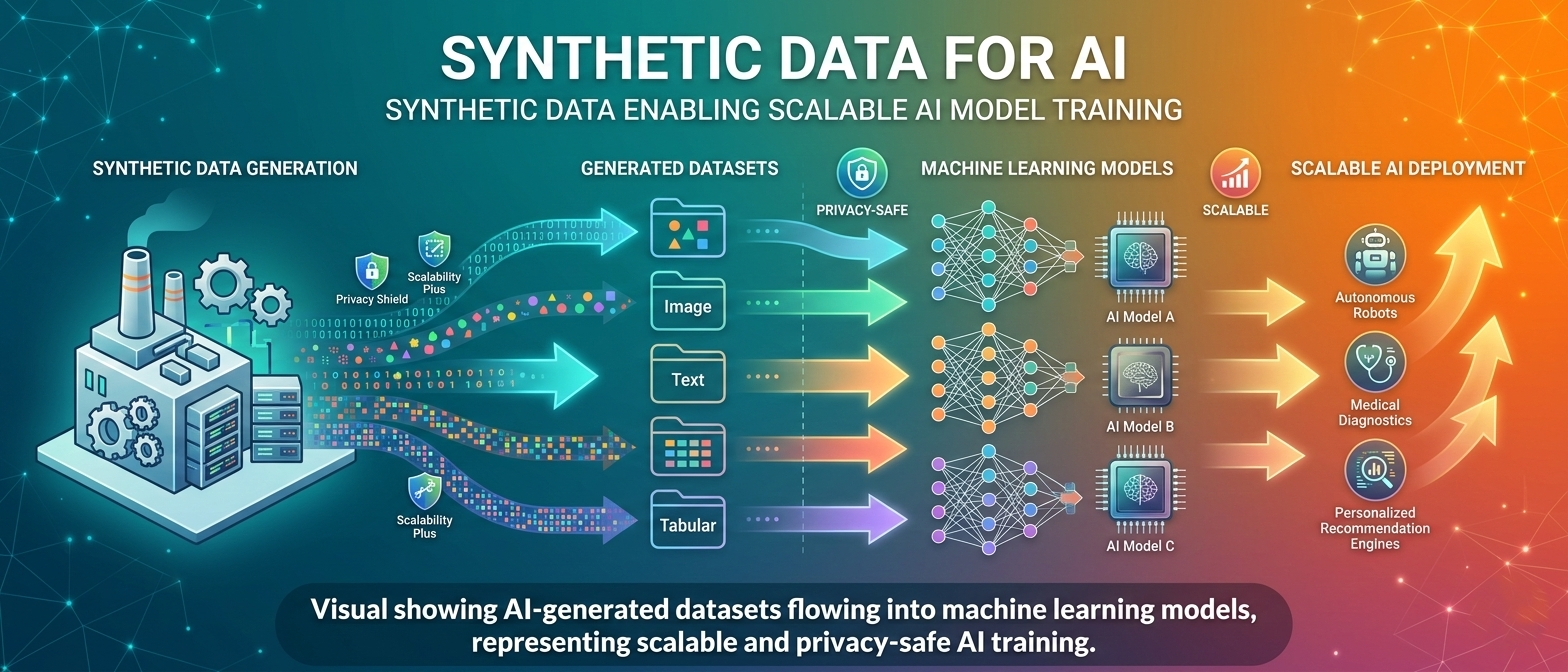
Synthetic data is rapidly emerging as a powerful alternative to real-world data in AI development. As organizations face increasing challenges around privacy, data scarcity, and compliance, synthetic data is becoming a critical enabler of scalable and responsible AI.
In 2026, businesses are no longer asking whether synthetic data is viable they are exploring how quickly they can adopt it to gain a competitive edge.
What Is Synthetic Data?
Synthetic data is artificially generated data that mimics real-world data patterns without directly using actual data.
It is created using:
- Machine learning models
- Statistical simulations
- Generative AI techniques
The goal is to produce data that behaves like real data while eliminating risks associated with sensitive or limited datasets.
Why Synthetic Data Is Gaining Momentum
Enterprises are increasingly turning to synthetic data due to several limitations of real data.
Data Privacy Regulations
Strict regulations make it difficult to use real user data freely.
Limited Data Availability
Some industries lack sufficient data for effective AI training.
High Data Collection Costs
Gathering and labeling real data can be expensive and time-consuming.
Synthetic data solves these challenges by providing scalable and compliant alternatives.
Key Benefits of Synthetic Data
Enhanced Privacy
Since synthetic data does not contain real personal information, it reduces privacy risks significantly.
Scalability
Organizations can generate large volumes of data quickly, enabling faster AI development.
Cost Efficiency
It eliminates the need for expensive data collection and labeling processes.
Improved Model Performance
Synthetic datasets can be tailored to include rare scenarios, improving model accuracy.
Use Cases Across Industries
Synthetic data is transforming multiple sectors:
Healthcare
Used to train AI models without exposing sensitive patient information.
Financial Services
Helps simulate fraud detection scenarios and risk analysis.
Autonomous Systems
Enables training of AI systems in simulated environments.
Retail and E-commerce
Supports demand forecasting and customer behavior analysis.
Synthetic Data vs Real Data
While synthetic data offers many advantages, it is not always a complete replacement.
- Real data provides authenticity and real-world complexity
- Synthetic data provides scalability and safety
The most effective approach is often a combination of both.
Challenges of Synthetic Data
Despite its benefits, synthetic data comes with certain challenges.
Data Accuracy
Poorly generated synthetic data can lead to inaccurate AI models.
Bias Replication
If the original data contains bias, synthetic data may replicate it.
Validation Complexity
Ensuring synthetic data matches real-world patterns requires careful validation.
How Businesses Can Get Started
Define Clear Objectives
Understand where synthetic data can add the most value.
Use Reliable Tools
Leverage advanced AI tools to generate high-quality datasets.
Combine with Real Data
Use hybrid datasets for better accuracy and reliability.
Continuously Monitor Performance
Evaluate how models perform with synthetic data over time.
The Future of Synthetic Data
Synthetic data is expected to play a major role in the evolution of AI.
Future trends include:
- AI-generated synthetic environments
- Real-time synthetic data generation
- Integration with digital twins
- Increased adoption in regulated industries
As technology advances, synthetic data will become more realistic and widely accepted.
Common Mistakes to Avoid
One common mistake is relying entirely on synthetic data without validation.
Businesses must ensure that synthetic datasets accurately represent real-world conditions.
Another mistake is ignoring bias. Synthetic data should be carefully designed to reduce, not amplify, existing biases.
Conclusion
Synthetic data is redefining how organizations approach AI development in a data-constrained and privacy-focused world. It provides a scalable, cost-effective, and compliant alternative to traditional data sources, enabling faster innovation and broader AI adoption.
As enterprises continue to invest in artificial intelligence, the ability to generate and utilize high-quality data will become a key differentiator. Synthetic data offers a practical solution to overcome data limitations while maintaining strong governance and compliance standards. In 2026 and beyond, businesses that strategically adopt synthetic data will be better positioned to build robust, ethical, and high-performing AI systems.
The future of AI is not just about algorithms, it is about the data that powers them.

Great information shared.. really enjoyed reading this post thank you author for sharing this post .. appreciated