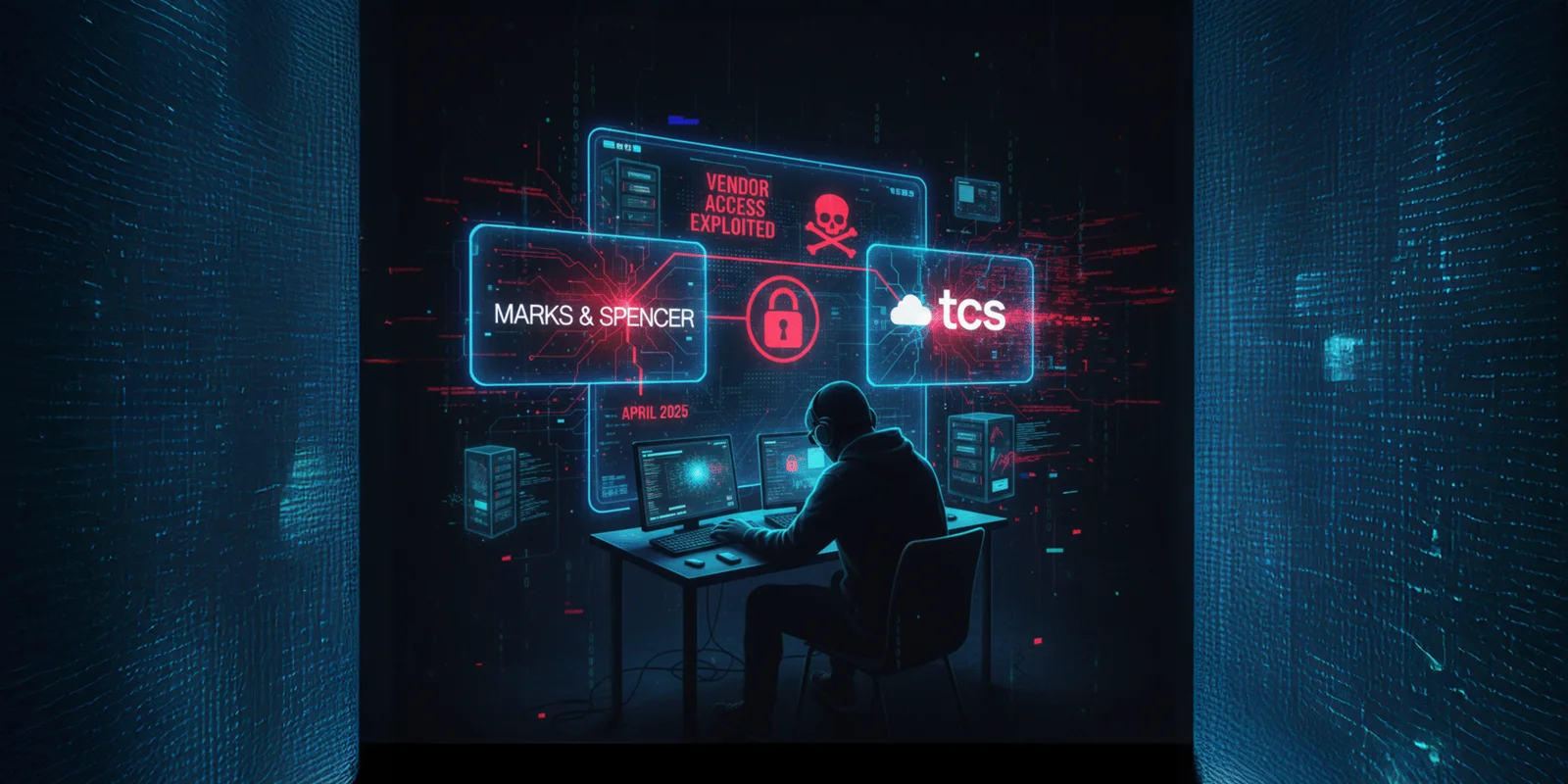

The M&S cyber attack 2025 shows how a major retailer’s trusted IT system collapsed due to a third-party access point. For tech firms and HRTech vendors, the lesson is clear: weak vendor controls, easy help-desk access, and social engineering still create the biggest exposure. When outsourcing partners hold keys to your systems, their gaps become your crisis.
What Happened in the M&S Cyber Attack 2025
In April 2025, Marks & Spencer (M&S) revealed it had experienced a highly sophisticated cyberattack. Attackers bypassed the retailer’s primary defences by compromising a third-party contractor rather than breaking in directly.
For 46 days, M&S suspended new online orders, causing significant disruption to its clothing and home business . The cost to operating profit was estimated at around £300 million (~$400 million) in the year 2025/26 .
The breach also leaked some personal customer information, though M&S confirmed no payment card data was compromised .
The UK retail sector took notice. The hacking group Scattered Spider (linked to ransomware operations) was later named in investigations.
Vendor Risk & Outsourcing Lessons for Tech and HRTech Providers
Outsourcing IT, HR, or support services can improve efficiency. However, the M&S attack shows that outsourcing also transfers risk. Key take-aways for tech and HRTech firms include:
- Ensure contracts include vendor breach clauses, not just service-level agreements.
- Apply least-privilege access controls so third parties only access what’s required.
- Conduct social-engineering drills for partner help-desk teams.
- Monitor vendor access in real-time and trigger alerts for unusual activity.
- Regularly review vendor relationships—with both cost and security as core criteria.
HRTech vendors managing employee data must also audit subcontractors. If a help-desk staffer has broad access, a single exploited credential can cascade across systems.
Human Error, Social Engineering & the Hidden Access Point
The breach at M&S reportedly originated through impersonation of help-desk staff at a vendor rather than direct system hacking. One expert noted: “A single vulnerability in your supply chain can cascade across the entire network.”
This illustrates a weakness many tech and HR vendors underestimate. Security isn’t just firewalls and encryption—it’s the human process, the help-desk script, and the vendor governance.
Don’t assume your in-house team is the only risk. If you outsource or partner, treat external access with equal scrutiny.
Business & Reputation Impact for Vendors
The operational cost to M&S was substantial. Online trading suspension lasted weeks, and the profit hit was projected at £300 million . The market value of the company dropped by over £1 billion in early May.
Even though vendor Tata Consultancy Services (TCS) was later cleared of direct compromise, the client still terminated its service-desk contract in October 2025 .
For tech firms and HRTech providers, the message is clear: reputation risk is as real as financial risk. A vendor’s weakness can lead to client loss, contract non-renewal, and trust erosion.
Mobile & Accessibility Considerations for Tech Vendors
In our mobile-first era, tech and HRTech vendors must ensure:
- Mobile dashboards that show live vendor access and alerts even when away from the office.
- Push notifications for unusual vendor logins or shared credentials.
- Accessibility-enabled controls so remote or field staff can check vendor status securely.
These mobile-centric practices reduce risk while supporting flexible work environments.
Strategic Response: What Tech & HRTech Firms Should Do Now
- Conduct a vendor access audit: list every partner with system access and review their permissions.
- Strengthen identity & access management: enforce MFA, biometric verification, and time-limited credentials.
- Implement vendor incident-response protocols: ensure subcontractors follow your security standards.
- Enhance employee & partner training: uncover social-engineering tactics and test help-desk protocols.
- Use cross-platform monitoring tools: integrate vendor logs into your HRTech analytics pipeline for clear visibility.
By proactively addressing these risks, vendors position themselves as security-first partners—a key differentiator in 2025’s service market.
Conclusion
The M&S cyber attack 2025 is more than a headline—it is a strategic warning for technology, outsourcing, and HRTech firms. The breach proves that external access, social engineering, and vendor processes can compromise even the best-defended organisations. If your company works with clients, uses subcontractors, or integrates third-party services, security must be embedded at every layer.
Tomorrow’s trusted vendors will be those who combine strong technical controls with human-centric governance. In 2025, your vendor-governance framework can no longer be optional—it is the new standard of service excellence.