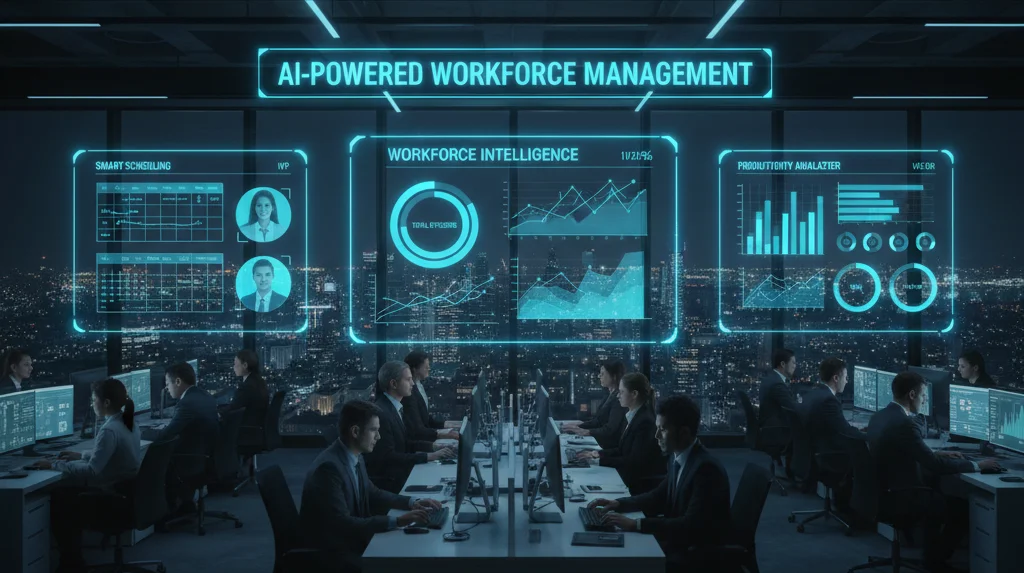

AI-powered workforce management is redefining how enterprises operate in 2026. As organizations navigate hybrid work models, talent shortages, and increasing operational complexity, traditional workforce systems are no longer enough.
For decades, workforce management focused on time tracking, attendance, and basic HR administration. Today, enterprises require intelligent systems that can predict workforce needs, optimize productivity, and enhance employee experience at scale.
This shift has positioned AI-powered workforce management as a critical layer of modern enterprise infrastructure.
What Is AI-Powered Workforce Management?
AI-powered workforce management refers to the use of artificial intelligence and machine learning to optimize how organizations manage, support, and develop their workforce.
Instead of relying on static rules and historical reports, AI-driven systems analyze real-time employee data to generate predictive insights and automated recommendations.
These systems help organizations:
- Forecast workforce demand
- Optimize scheduling
- Analyze performance patterns
- Identify skill gaps
- Predict attrition
- Enhance employee engagement
AI does not replace HR teams. It augments human decision-making with intelligence.
Why Traditional Workforce Systems Are No Longer Enough
Legacy workforce tools were designed for stable, on-site work environments. They struggle to support modern realities such as:
- Remote and hybrid teams
- Gig and contract workers
- Global compliance requirements
- Rapid skill evolution
- Employee burnout
Manual planning cannot scale to these complexities.
Enterprises now need adaptive systems that continuously learn and respond to workforce dynamics.
How AI Is Transforming Workforce Operations
1. Predictive Workforce Planning
AI models forecast staffing needs based on demand patterns, project pipelines, and business growth.
This helps organizations prevent:
- Understaffing
- Overstaffing
- Skill shortages
Workforce planning becomes proactive instead of reactive.
2. Intelligent Scheduling
AI automatically builds optimized schedules based on availability, performance, preferences, and compliance rules.
This improves:
- Employee satisfaction
- Operational efficiency
- Work-life balance
And reduces human scheduling errors.
3. Performance and Productivity Insights
AI analyzes work patterns, collaboration data, and output metrics to identify high-performing behaviors.
Managers gain visibility into:
- Productivity trends
- Bottlenecks
- Team effectiveness
Without micromanagement.
4. Skill Intelligence and Upskilling
AI identifies emerging skill gaps and recommends personalized learning paths.
Organizations can align training investments with future business needs.
This turns workforce development into a strategic growth engine.
5. Attrition and Engagement Prediction
AI models detect early signs of disengagement, burnout, or resignation risk.
HR teams can intervene early through:
- Career development
- Workload balancing
- Compensation reviews
Reducing costly employee turnover.
Business Impact of AI-Powered Workforce Management
Organizations adopting AI-powered workforce management report:
- Higher productivity
- Lower attrition
- Better employee experience
- Improved compliance
- Stronger talent retention
Workforce decisions become data-driven instead of intuition-based.
HR evolves from administrative support to strategic leadership.
Ethical and Practical Considerations
While AI offers powerful benefits, enterprises must address key concerns.
- Data privacy must be protected.
- Bias must be monitored.
- Transparency must be ensured.
AI systems should support fairness, not surveillance.
Human oversight remains essential.
The Future of Workforce Management
By 2030, most enterprises will operate fully intelligent workforce systems.
Future capabilities will include:
- Autonomous workforce orchestration
- Real-time labor market intelligence
- AI-driven career pathing
- Emotional intelligence analytics
- Continuous compliance automation
Workforce management will become a living system that adapts in real time.
Conclusion
It moves organizations beyond time tracking and administrative processes into predictive, intelligent workforce ecosystems. In a world where talent is the most valuable asset, enterprises that adopt AI-driven workforce strategies will gain long-term competitive advantage.
The future of work is not just digital.
It is intelligent.